Summary
The cost of a 3D website depends less on “3D” itself and more on five things: how many models you need and where they come from, how interactive the experience is, how much effort goes into mobile performance, how much content surrounds the 3D, and what it must connect to.
1. The 3D models: source, count and detail
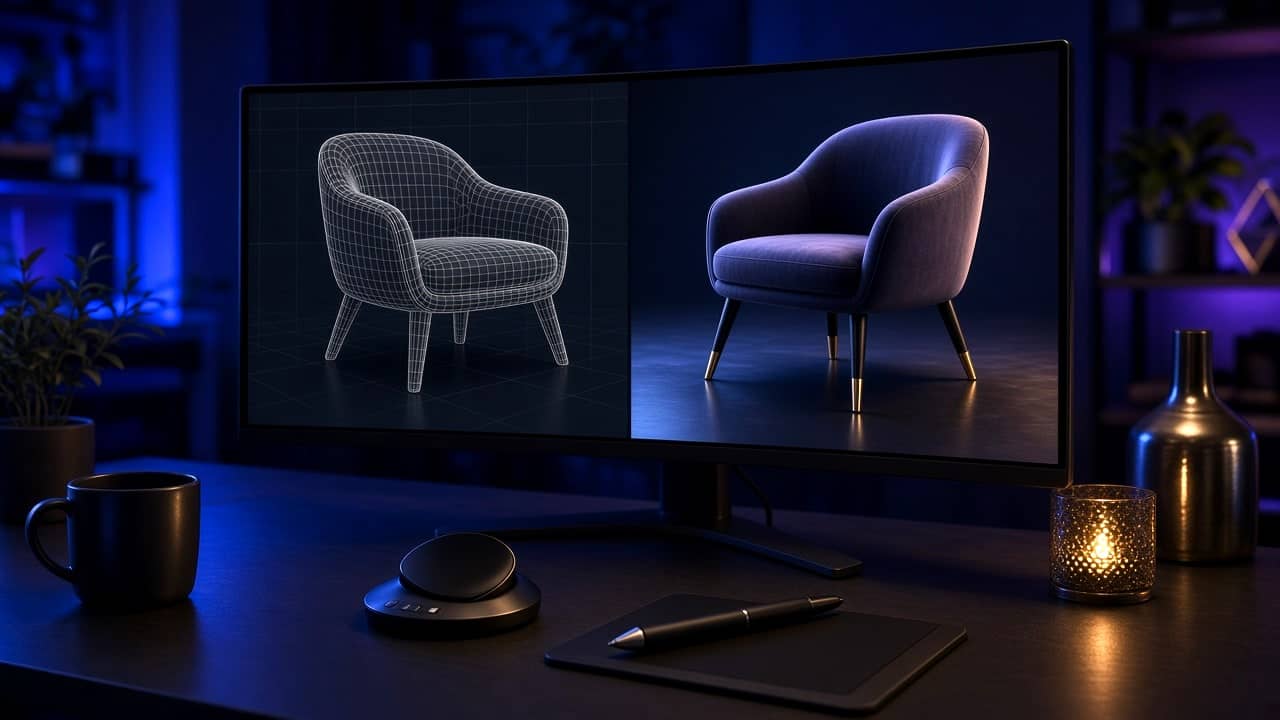
The biggest single factor is the 3D assets. If you already have CAD or design files for your products, they can usually be converted and optimised for the web. If nothing exists, models must be created from photos, drawings or reference products, which takes considerably more work.
Detail matters too. A model meant to be inspected up close needs accurate geometry and materials; a decorative hero object can be much simpler. More product variants (colours, sizes, configurations) multiply the asset work.
- Do you have CAD, STEP, FBX, GLB or similar files?
- How many distinct products or variants must be shown?
- Will people zoom in closely, or see the object from a distance?
2. Interactivity: viewer, configurator or experience
A product viewer that lets people rotate and zoom is the simplest form. A configurator that changes colours, materials or parts — and updates price or stock from your systems — adds logic and testing. Fully guided experiences with scroll-driven animation, camera paths and storytelling are the most involved.
3. Performance on real phones
A 3D website that only works on powerful laptops loses most visitors. Good engineering compresses models and textures, loads the 3D scene after the main content is visible, and provides a lightweight fallback image for weaker devices or people who prefer reduced motion.
This optimisation work is invisible when done well, but it is often what separates a 3D site that helps sales from one that hurts search rankings and conversions.
4. The rest of the website
The 3D element is usually one part of a full site: pages, copy in one or more languages, SEO, forms, analytics and a content management system. A bilingual Arabic/English site needs proper right-to-left layouts, not just translated text.
5. Integrations and ongoing updates
Connecting the experience to an online store, ERP, CRM or inventory system adds scope. So does the need for your team to add new products and models later without a developer — which calls for a clear asset pipeline and admin tools.
How to get an accurate quote
Prepare a short brief: the products to show, any existing 3D or design files, the interactions you want, the languages, and the systems it should connect to. With that, an agency can give you a written scope and estimate instead of a guess.
Services related to this topic

Website & Web App Development
Fast, bespoke landing pages, company sites, booking sites and web apps — with 3D experiences when they serve your brand.
- Landing pages for campaigns and products
- Bilingual company websites
- Booking and appointment websites
Content Creation & Creative Design
Posts, stories, reels, motion graphics and marketing copy that express your brand clearly.
- Post, story and ad designs
- Short-form videos (Reels) and motion graphics
- 3D designs and product renders

SEO & GEO
Clearer visibility in search results and in AI assistant answers.
- Technical SEO audit and site speed
- Keyword research and content plan
- Schema.org structured data